
We thought it would be helpful to put what we see as the key ingredients of car club growth together in a graphic for all to use (with a credit to us as its source).
You will see we think there is a need for authorities to coordinate support across the transport, planning, fleet management, travel planning, parking and communications teams to create the right eco-system for car club success.
This document provides the key points for local authorities to consider in setting up a car club in their area.
Car club operators as well as local authorities are feeling the effects of many financial pressures. The guidance aims to reduce this burden and accelerate the contribution car clubs can make to policy goals. By following these points, it will maximise interest from operators, it will help save time and money on procurement administration and it will ultimately ensure a successful scheme, delivering a long-term sustainable car club operation.

This analysis of the extra cost of managing EVs in car club fleets draws upon data from car club operators to inform stakeholders about the economic realities. It finds that EVs are costing operators an average of over £6,000 more per year than internal combustion engine or hybrid cars.

Research carried out by CoMoUK has found how car club users can usually save up to £6,000 per year across a large range of scenarios using an EV car club vehicle rather than owning or leasing an EV.

Discover practical strategies and toolkits for promoting car clubs in your local area or organisation.
This guidance document outlines effective engagement and marketing approaches designed for local authorities and employers to shift public habits away from private car ownership toward sustainable, cost‑effective shared transport solutions.

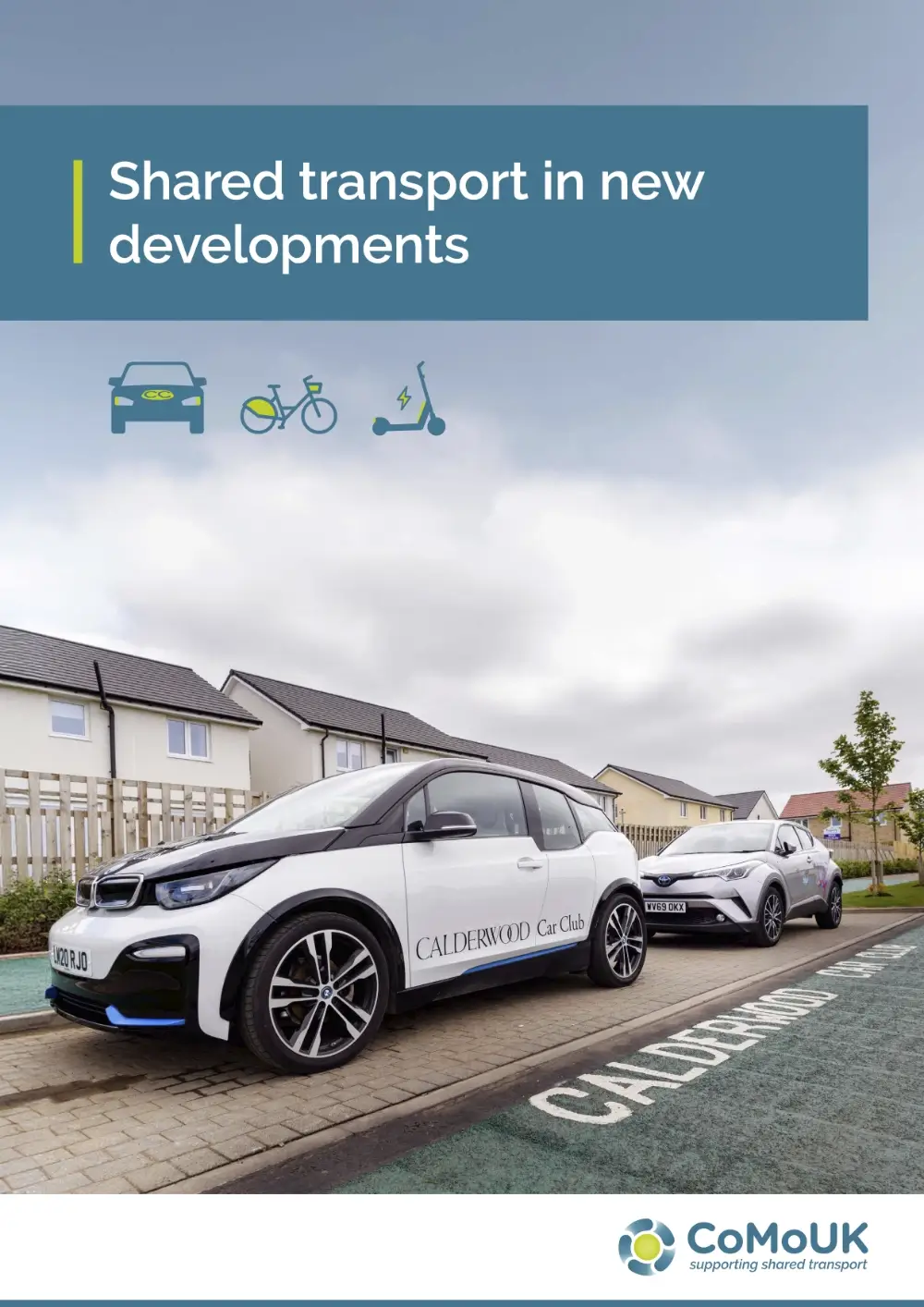
Shared transport in new developments is a practical guidance document designed to help local authorities, urban planners, and housing developers integrate shared mobility schemes into new residential projects. Moving away from traditional car-centric planning, it champions a vision-led approach where sustainable transport—such as car clubs, bike share systems, e-scooters, demand-responsive transit, and mobility hubs—is embedded from the point of first occupation. The guide details the substantial social and environmental benefits of this transition, highlighting how shared transport can drastically cut carbon emissions, reclaim public land, and replace up to 23 private vehicles for every car club car introduced.
The report outlines actionable strategies to support low-car living, recommending private parking ratios of under one space per home, edge-of-development parking design, and early collaboration with shared transport operators. It also provides clear guidance on leveraging developer contributions—such as Section 106, Section 75, and Section 76 agreements—to fund long-term fleet viability and resident travel incentives. Supported by real-world UK case studies ranging from Leeds and Aberdeen to London and Swindon, this document offers an essential blueprint for creating connected, walkable, 20-minute neighbourhoods.
Read our report on the status quo for EVs in car clubs and the steps we think need to be taken to ensure the UK gets the most out of virtuous circle of offering people much cheaper, occasional access to EVs rather than solely focussing on privately-owned EVs.

This ground-breaking action kit for employers about how shared transport can fit into wider packages of options that decarbonise staff, visitor, supply chain and patient travel.
It has a range of fascinating case studies to take inspiration from and how to identify goals, assess patterns, choose changes and make a success of them.

Driving London Forward is ground-breaking work from CoMoUK with associate members Steer on the potential for future car club services in the city.
Take a look to see how we calculated this, as well as our recommendations on the policies our capital city needs in relation to car club to take even more private cars off London’s roads.

Peer-to-peer car sharing is the 'Airbnb' version, whereby users hire another private individuals' car via the peer-to-peer platform. Our explanatory guidance has more detail.


